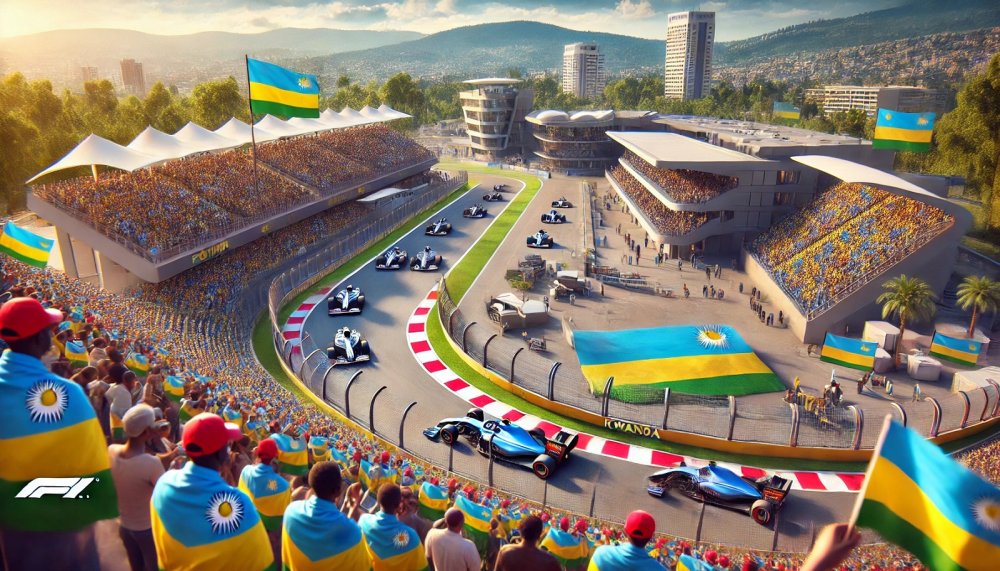
Plans are underway for Rwanda to build Formula One racing circuits in Bugesera District, close to the site of the new international airport currently under construction. The information was revealed by Ugandan journalist Andrew Mwenda, who spoke about Rwanda’s long-term development ambitions.
Andrew Mwenda was among participants in a recent high-level meeting held by President Paul Kagame with his advisers. The discussions focused on key strategic areas including energy, infrastructure development, air transport, tourism, and plans to increase Rwanda’s gross domestic product fivefold over the next 15 years.
Speaking during an interview on The Longform with Sunny Ntayombya, Mwenda said that one of the major projects discussed was the construction of Formula One racing infrastructure. According to him, Rwanda is interested in hosting Formula One races, and the proposed circuits would be built in Bugesera, near the new airport.
Mwenda explained that presentations were made by the Minister of Infrastructure, Jimmy Gasore Kabera, and the CEO of the Rwanda Development Board (RDB), Jean-Guy Afrika. They outlined Rwanda’s broader development plan for the area surrounding the new airport, including transport networks, business zones, and international-standard facilities that could support major global events.
He added that the Formula One project is part of Rwanda’s vision to position itself as a global destination for sports and tourism. Mwenda noted that although several African countries such as Algeria, Egypt, Nigeria, and Kenya have larger economies, Rwanda’s leadership believes it can successfully deliver such a project. He also pointed out that South Africa previously attempted to host Formula One again but did not succeed, while Rwanda is now pushing forward with confidence.
In December 2024, Rwanda officially confirmed that it had submitted its candidacy to host a Formula One race, marking a significant step toward bringing the world’s top motorsport competition back to Africa. South Africa was the last African country to host a Formula One race, in 1993.
To host a Formula One Grand Prix, a country must first build circuits that meet strict international standards. These circuits fall into two main categories: street circuits, which use existing public roads with controlled speeds and limited overtaking, and race tracks, which are purpose-built and allow cars to race at very high speeds.
The cost of building a Formula One circuit varies depending on the country, design quality, and size of the track. Estimates generally range between 250 billion and 500 billion Rwandan francs. However, the United Arab Emirates built the most expensive circuit to date, costing approximately 1.61 trillion Rwandan francs.
One of the smallest and least complex circuits currently in use is Watkins Glen International in the United States. It covers about two square kilometers and has a seating capacity of 38,900 spectators. This example is often used to estimate what Rwanda would need to build a competitive and compliant Formula One facility.
Track construction requires special attention due to the extreme speeds of Formula One cars and the heat generated by their engines. In addition to the main racing track, there must be secondary service roads not used during races. Depending on location and materials, the base cost of the track alone can reach around 125 billion Rwandan francs, including track markings and safety features.
Spectator stands are another major requirement. Their cost depends on seating capacity and supporting facilities such as access routes and safety infrastructure. If Rwanda were to build stands accommodating more than 35,000 spectators, the cost could exceed 30 billion Rwandan francs.
A Formula One circuit must also include a pit complex, where cars refuel, change tires, and undergo repairs during races. This area is usually built near the start and finish line and can cost around 50 billion Rwandan francs for a medium-sized facility.
Media facilities are also essential, as Formula One is a global broadcast event. Media centers must be equipped with advanced technology to support live coverage, interviews, and race analysis. These facilities alone can cost at least 15 billion Rwandan francs.
Because Formula One races involve high risks and frequent accidents, a fully equipped medical center is mandatory. This facility must operate at the level of a modern hospital and typically costs no less than 5 billion Rwandan francs.
Finally, advanced technology systems are required to support race operations and fan experience. These include high-definition screens, tracking cameras, replay systems, timing technology, and digital advertising boards. The cost of these systems can exceed 30 billion Rwandan francs.
If completed, the Bugesera Formula One project would position Rwanda as one of the few African countries to host this prestigious motorsport event, potentially becoming the second on the continent to do so after South Africa.

Post Comment